Winter Illuminations in Akita, Japan: Hikari no Fantasy Guide
Masanori Kato
Akita no Mikata
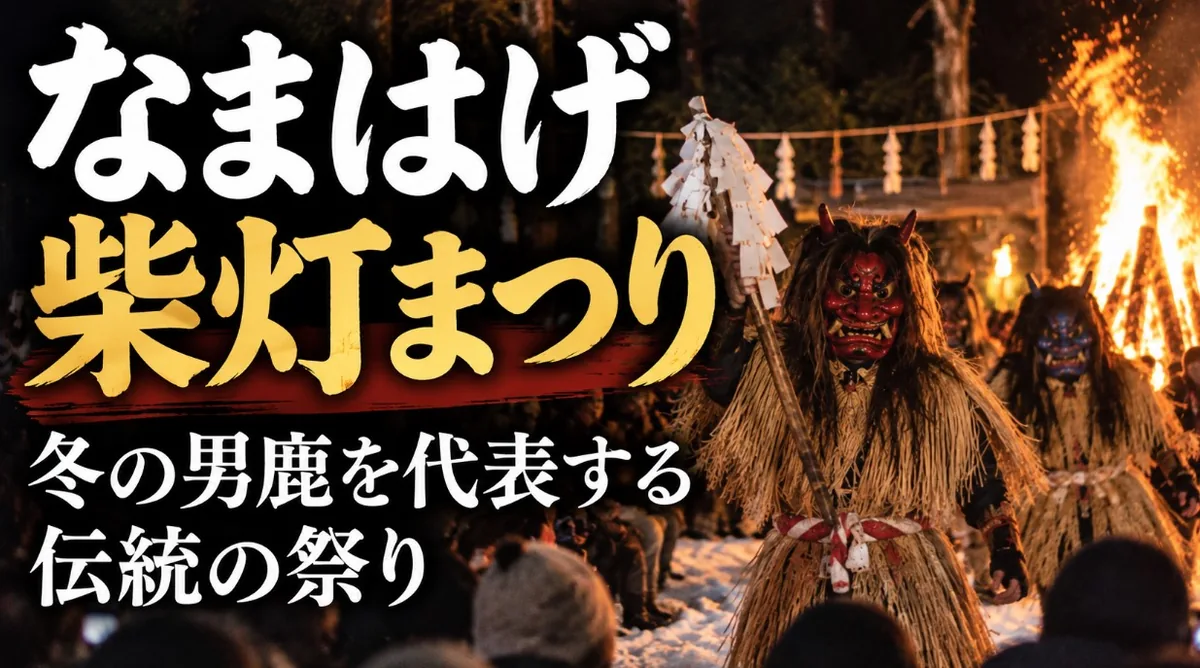
Every February, on a snowy mountain in Oga, Akita, in northern Japan, a line of torches appears out of the dark forest. One by one, Namahage — the masked, straw-clad deities of the Oga Peninsula — come down the mountain toward a huge bonfire. This is the Namahage Sedo Festival (なまはげ柴灯まつり, Namahage Sedo Matsuri), one of the five great snow festivals of northern Japan.
I live in Akita and have been to the festival myself. It is unforgettable — but it is not a festival you can just show up to. Entry is by advance registration only, the venue is a mountain shrine with no regular bus service, and you will stand in the snow for over two hours at below-freezing temperatures.
This guide covers everything a first-time visitor from overseas needs: dates, how to get tickets, how to get there from Tokyo or Akita, what happens on the night, what to wear, and what to eat. Information is based on my own visit, visitor reviews, and the official festival website.
Note: All images in this article are AI-generated illustrations.
Next festival at a glance (64th festival, 2027)
Checked against the official website in November 2026. Details can change, so please check the official site before you travel.
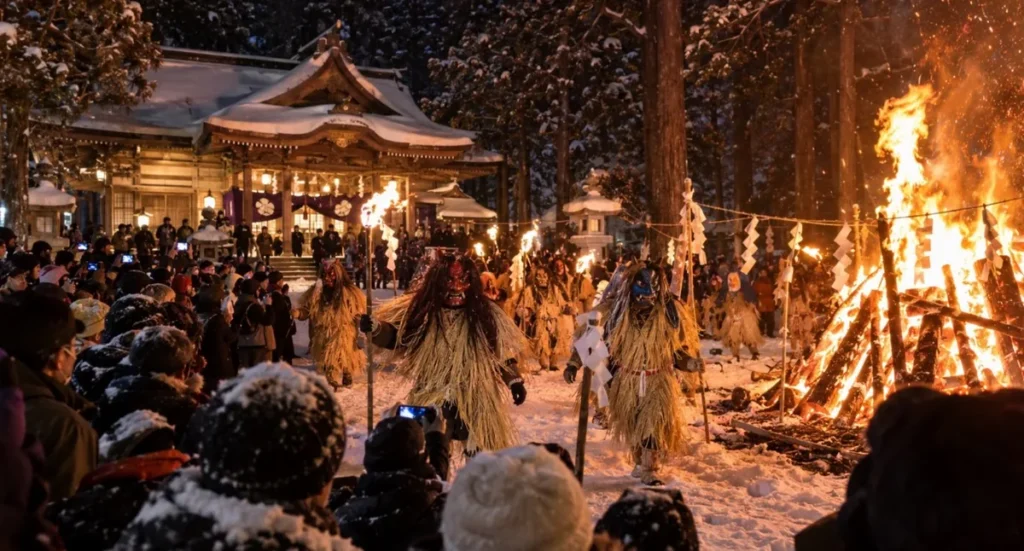
The festival is held every February at Shinzan Shrine in Oga City, Akita Prefecture. It combines two traditions:
Normally, Namahage only appear inside local homes on 31 December, so outsiders almost never get to see them. The festival brings them out into the open, framed by a Shinto ritual, so that visitors can experience them too. You get the solemn atmosphere of a shrine ceremony and the raw power of the Namahage in a single night.
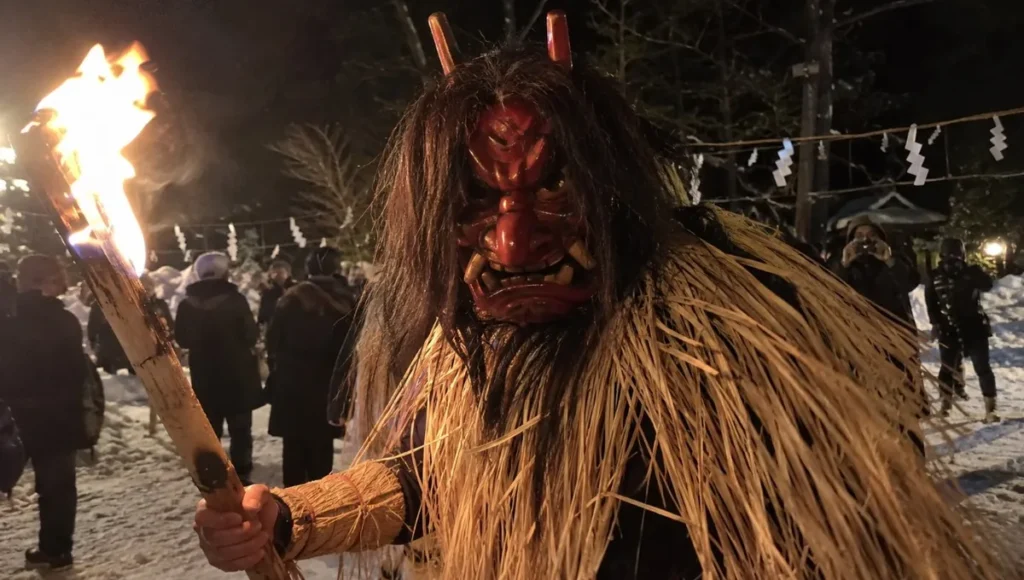
“Naku ko wa inee ga!” — “Are there any crying children here?” “Namakemono wa inee ga!” — “Any lazy people here?”
Roaring these words, Namahage stomp into homes on New Year’s Eve. They look like demons, but they are not. In Oga they are understood as raiho-shin (来訪神), “visiting deities” — gods who come down from the sacred mountains of Shinzan and Honzan once a year. They scold children and lazy family members, but they also drive away bad luck and bring a good harvest, a good catch at sea, and a safe year for the household. Scary and kind at the same time: that is the true nature of a Namahage.
If you sit by the hearth too long in winter, red heat blotches called namomi form on your skin — proof that you have been idle instead of working. Peeling them off (namomi-hagi) to punish laziness is said to have become “Namahage” over time.
There are also local legends. In one, demons brought to Oga by the Han Emperor Wu of China made a bet with the villagers: if they could build 1,000 stone steps in a single night, they could take a village girl. When they reached step 999, a villager imitated a rooster’s crow, and the demons fled back into the mountains, thinking dawn had come.
Customs vary by village, but the visit roughly goes like this:
Oga no Namahage was designated an Important Intangible Folk Cultural Property of Japan in 1978. In 2018 it was inscribed on UNESCO’s Representative List of the Intangible Cultural Heritage of Humanity as part of “Raiho-shin, ritual visits of deities in masks and costumes.” With fewer young people in rural Oga, fewer villages keep the New Year’s Eve custom alive than before — which makes the festival an important way of passing the tradition on.
The festival runs for three days — the Friday, Saturday and Sunday that include the second Saturday of February — from 18:00 to 20:30 each evening. So if you are planning a future trip, find the second Saturday of February and you will know the approximate dates. The 2027 festival is on 12–14 February.
Shinzan Shrine is in the mountains, away from the town center, so plan your transport and cold-weather gear carefully.
This is where most first-timers get caught out. You cannot buy a ticket at the venue. You must register and pay in advance.
The shrine grounds are not large, so numbers are capped for safety — 1,800 people per day for the 64th festival. When I went, the cap meant it never got uncomfortably packed. But because the space is small, other people’s heads can block your view, so moving around for each performance makes a big difference (tips below).
Registration closes early once a day is full, and Saturday tends to fill up first. Book as soon as you can. Some reviewers mention missing out because they registered too late.
There is no regular bus service to Shinzan Shrine. Use the festival’s temporary shuttle bus, a taxi, or a car.
Take the JR Oga Line from Akita Station to Oga Station (about 55 minutes, ¥770 one way). Trains are infrequent, so check the timetable. The official site lists the 13:44 and 15:27 departures from Akita as convenient options. The Oga Line is a JR East line, so JR passes that cover JR East should be valid — check the conditions of your pass.
Temporary shuttle buses run on festival days. ¥1,000 per person (free for junior high school students and younger), unlimited rides on the day, no reservation required. (Times below are from the official site for the 64th festival.)
| Route | To the shrine | Back from the shrine |
|---|---|---|
| Michi-no-Eki Oga (next to JR Oga Station) — about 30 min | 15:15, 16:15, 17:15 | Leave when full, 19:45–21:00 |
| Oga Onsen (Oga Onsen Koryu Kaikan Gofu) — about 20 min | 16:40, 17:30 | Leave when full, 20:10–21:00 |
Door to door, Akita Station to the shrine takes about 2 hours by train and shuttle. The last trains back to Akita on the official list leave Oga at 21:35 and 22:44. Return buses leave as soon as they are full, so there can be a long queue in the snow at the end of the night. If you need to catch a train, consider heading to the bus stop a little before the final performance ends.
Set your navigation to Namahage-kan (なまはげ館). Parking opens at 15:00, with about 540 spaces across five lots; the farther lots have free shuttles about every 20 minutes. Spaces near the shrine fill up early, and the busiest arrival time is 17:00–17:45.
Please be honest with yourself about winter driving. Roads can be snowy and icy, and you need proper winter tires. If you are not used to snow, the organizers recommend parking at Michi-no-Eki Oga and taking the shuttle. Ten “Heartful” parking spaces near the venue are available by reservation for pregnant women, families with infants, and people with disabilities (tel. +81-185-24-9220).
Over about two and a half hours, performances move around the shrine grounds — from the plaza entrance to the approach path, the kagura hall, the bonfire, and the mountain path. Knowing the flow helps you avoid ending up stuck behind the crowd.
| Time | Event | Where |
|---|---|---|
| 18:00 | Chinkamasai & Yu-no-Mai (purification ritual and dance) | Plaza entrance |
| 18:20 | Namahage Nyukon (spirit-entering ceremony) | Approach entrance |
| 18:35 | Re-enactment of the New Year’s Eve visit | Kagura hall |
| 18:55 | Namahage Dance | In front of the bonfire |
| 19:05 | Namahage Taiko drumming | Kagura hall |
| 19:25 | Namahage Descent & Rice-Cake Offering | Plaza and mountain path |
| 20:00 | Village Namahage appear | Kagura hall and plaza |
Example program from the official guide to the 64th festival. Times and content may change.
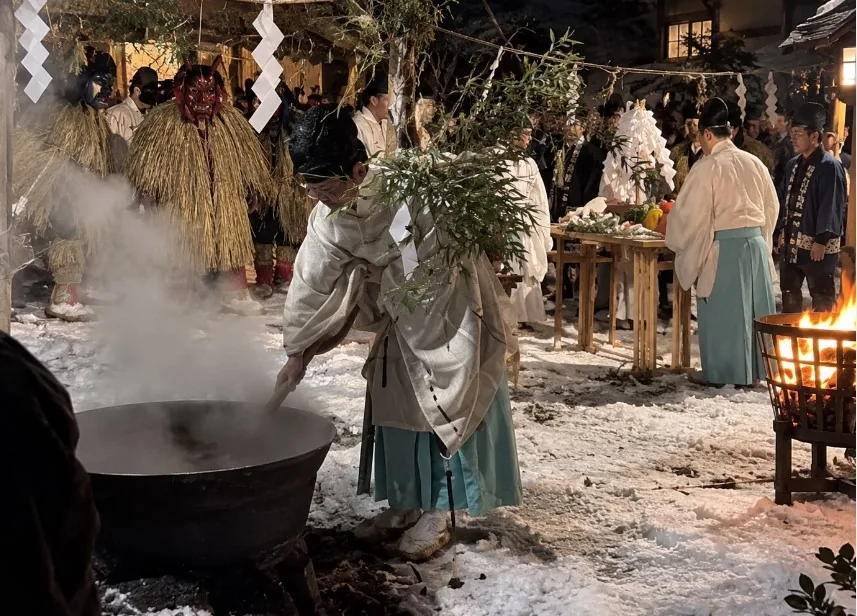
Water is boiled in a cauldron and offered to the gods with prayers for good health, followed by Yu-no-Mai, a purifying kagura dance from the Oga area. People are still finding their spots at this point, but the steam and the stillness remind you that this is a sacred ritual first and a tourist event second.
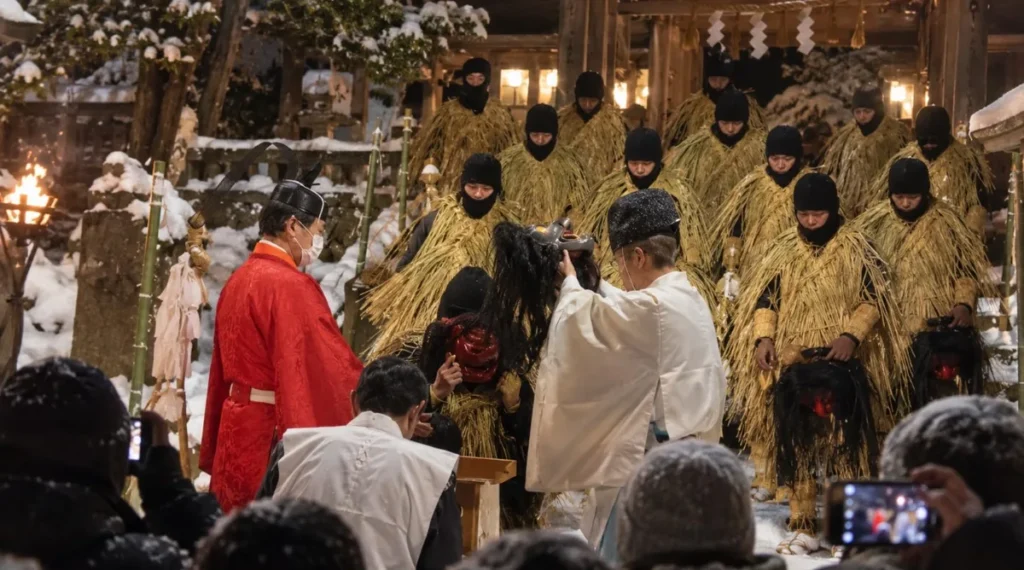
Local young men are purified by a priest and receive masks into which a divine spirit has been placed. Wearing them, they become Namahage and walk off into the mountain. It is not flashy, but it is one of the most tense and moving moments of the night: the noisy grounds go completely quiet.
At the kagura hall, the Namahage visit to a family home is performed: the stomping entrance, the host serving food and sake, and the conversation between them. This normally happens behind closed doors, so it is a rare chance to see it. The dialogue is in the Oga dialect — even if you cannot follow the words, listen to the rhythm and tone.
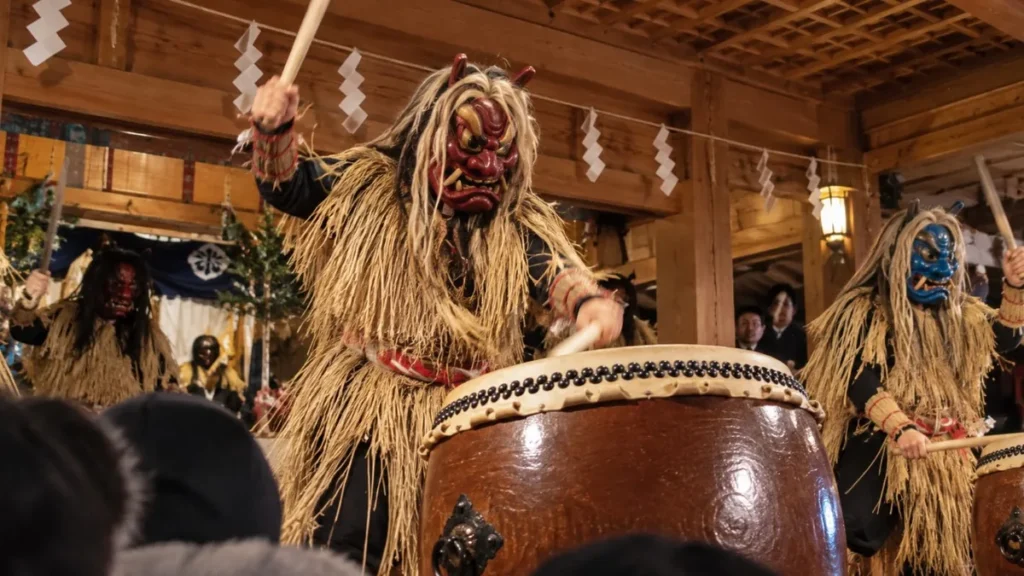
The Namahage Dance, performed in front of the roaring bonfire, was choreographed in 1961 by Akita-born modern dance pioneer Baku Ishii, with music by his son Kan Ishii. It is one of the most photogenic moments of the night. Then the Namahage Taiko begins: the deep boom of the drums and the Namahage’s roars are so powerful you briefly forget the cold.
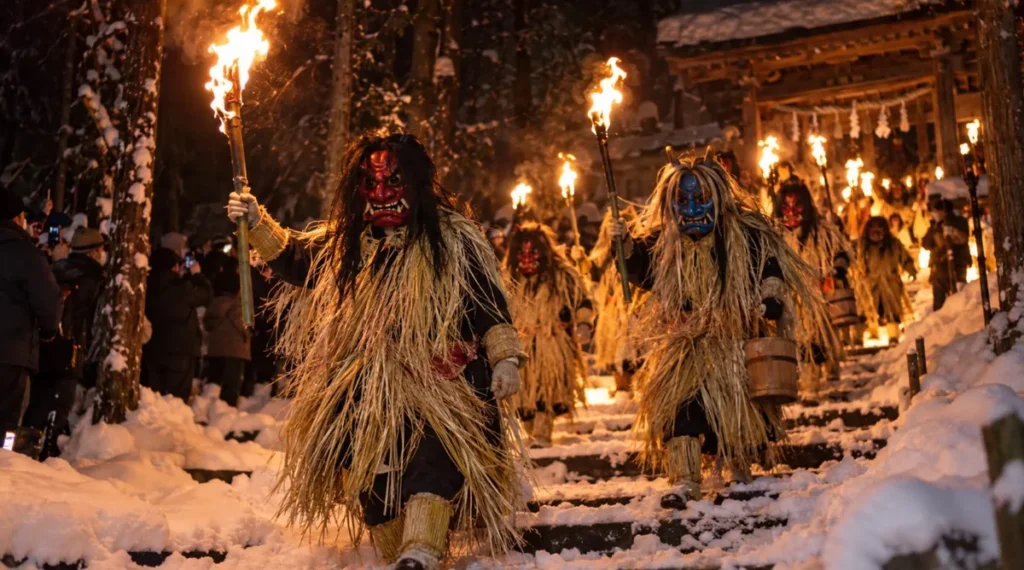
This is the moment everyone waits for. In the pitch-black mountain, torches appear one by one, and the Namahage come down the snowy path in a single line — the men who walked into the mountain at Nyukon, now returning as gods. The snow lit by the bonfire and the swaying torches create a scene you will not see anywhere else.
A priest then offers them goma-mochi, rice cakes toasted in the sacred fire (the kenpei offering). The Namahage hesitate and go back and forth before accepting — a slightly humorous moment in the middle of a solemn ritual. The rice cakes are believed to protect against fire, and pieces are sometimes shared with the audience.
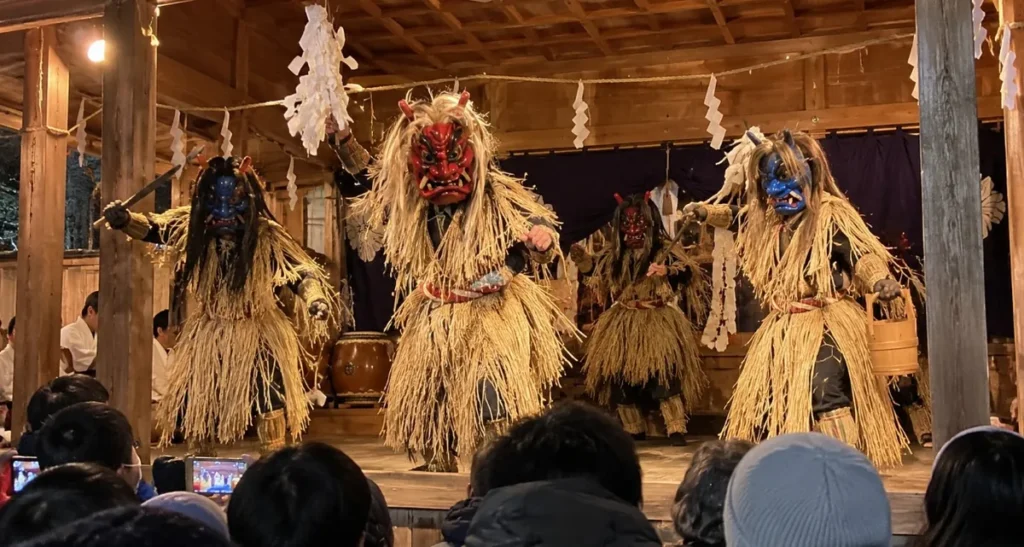
Each village has its own masks, costumes and customs. In the finale, Namahage from all over Oga rush into the crowd. You can compare the different styles — horns or no horns, red or blue faces — up close. Small children often burst into tears, which is all part of the experience.
Check the venue map on the official site before you go so you know where the kagura hall is and which path the Namahage come down. Viewing is standing only; there is a standing viewing area whose passes are issued first-come, first-served at the festival headquarters (matsuri honbu) on site.
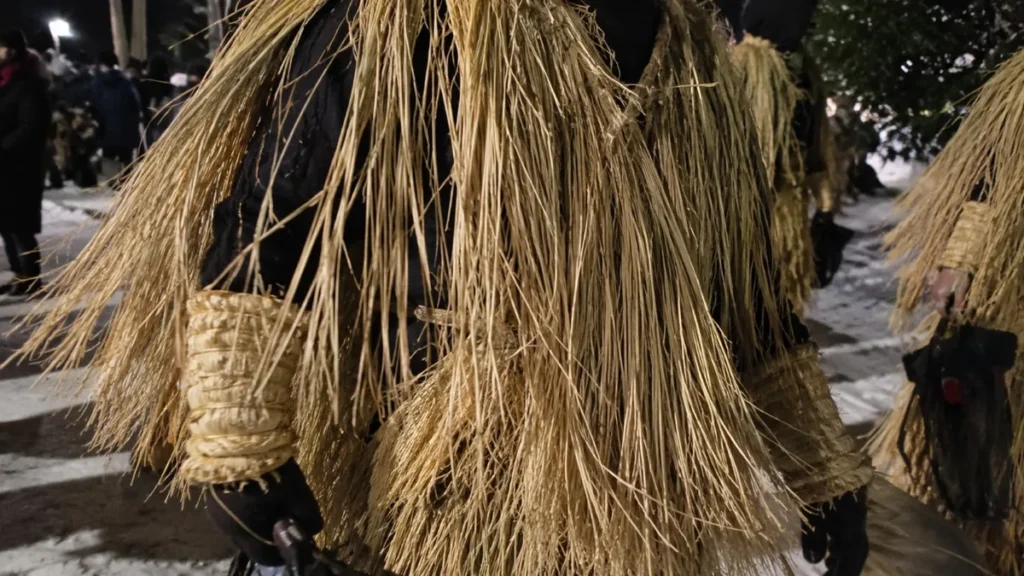
Straw that falls from a Namahage’s costume (kera) is considered a lucky charm for good health. Many visitors pick some up from the snow after the Namahage pass — and yes, I took some home too. Only pick up straw that has fallen naturally; never pull straw from a Namahage’s costume. They move so wildly that quite a lot falls off. I sometimes wonder if the costumes are made a little loose on purpose.
The following are not allowed (per the official guide to the 64th festival):
Since you will shoot handheld in the dark, try your phone’s night mode beforehand. Official photographers film the event for promotion, so you may appear in their photos.
Wheelchair users: there are steps at the entrance, and staff will help. However, the grounds are unpaved and moving around can be difficult when snow piles up. Families with small children: footing is poor and the night is cold, so bring a baby carrier and plenty of warm gear. It helps to tell children beforehand that Namahage are gods who scold bad behavior and bring happiness.
Watch your step and the sparks. The snow gets packed down and slippery, and some areas turn to slush from snow-melting agents. Sparks from the bonfire can also fly with the wind — several reviewers mention small holes burned into their favorite down jackets.
After getting your ticket, staying warm is the most important preparation. You will stand outdoors on snow for over two hours on a February night in the mountains, and temperatures often drop below freezing.
The real enemy is the cold coming up through your feet. Standing still on snow, the cold creeps up from the soles of your feet until your whole body is chilled. People who came in sneakers often say they lost feeling in their toes and nearly went home early.
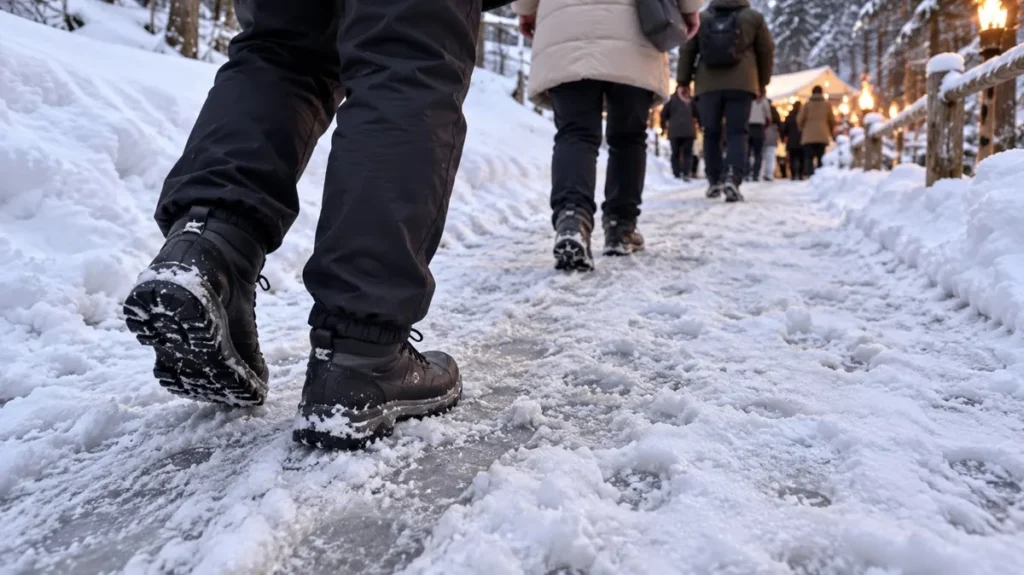
Wear waterproof snow boots with anti-slip soles, and two pairs of thick socks. Avoid heels and flat-soled shoes. You may also walk up a snowy slope from the parking lot, so your footwear matters before you even reach the shrine.
Nylon and other synthetic fabrics melt easily. If you want to watch near the bonfire, wear an outer layer you do not mind damaging, add a cotton layer on top, and avoid standing directly downwind of the fire for long.
Phone batteries drain fast below freezing — people report phones shutting off with 50% left. Keep your phone and power bank in an inside pocket with a hand warmer, and write down your bus and train times (and keep your ticket confirmation) on paper too.

Local people usually run food tents and a small canteen in the shrine grounds, serving hot food such as:
Local sake and hot sake are sometimes available too. Food tents get busy between performances, so eat before the parts you most want to see. Bringing some cash for food is a good idea.

Michi-no-Eki Oga, the roadside station next to Oga Station and the shuttle departure point, hosts a satellite event called “Sedolight” in some years, with Oga food stalls, taiko performances and even fireworks (in 2026, around 21:10 each night from a nearby harbor area — not at the shrine). Check that year’s official announcements for details.
I ate two things here that I can recommend:
My tip: eat a hot meal at Michi-no-Eki Oga around 16:00 and take the 17:15 shuttle. Going into the cold with a full stomach makes a huge difference. If you are drinking, take the shuttle or stay at Oga Onsen — and remember that alcohol makes you lose body heat faster, even if you feel warmer.

Right next to Shinzan Shrine are two facilities that make the festival far more meaningful:
Regular opening hours end at 17:00, so if you want to visit on festival day, arrive by car or early in the afternoon. Individuals do not need a reservation. Hours and performance times on festival days may differ, so please check in advance.
After hours in the snow, nothing beats a hot spring. Oga Onsen is a hot spring town near the Sea of Japan, about 20 minutes from the shrine by shuttle. Staying there means no snowy driving, you can enjoy local sake, and you can skip the rush for the last train. It is the most comfortable way to do the festival — just remember that booking your room and registering for the festival are usually separate.
No. Entry is by advance registration only, and the ¥2,000 admission (free for junior high school students and younger) must be paid online when you register. Cash is not accepted at the gate.
Usually around December. For the 2027 festival, registration is planned to open on 1 December 2026. Each day is capped at 1,800 people and closes when full.
Yes. Take the JR Oga Line from Akita to Oga Station, then the festival shuttle from Michi-no-Eki Oga (¥1,000, no reservation). If you stay at Oga Onsen, shuttles also run from there.
Yes, but plan your return carefully. The last trains from Oga to Akita leave around 21:35 and 22:44 (per the official site), and return shuttles leave when full, so allow time for queues.
Yes, and children of junior high school age and younger enter free. Just dress them very warmly — and be ready for tears when the Namahage come close. Pets are not allowed.
Yes. The Namahage Museum and the Oga Shinzan Folklore Museum, right next to Shinzan Shrine, are open year-round. At the folklore museum you can watch a re-enactment of the New Year’s Eve visit. The real house visits on December 31 are private family events.
February is peak winter in Akita. You can combine the festival with skiing at Akita’s ski resorts, the winter illuminations in Akita City and the Yokote Kamakura snow-hut festival in mid-February, one of the most snow-filled trips you can take in Japan.
Not as part of the shrine program. In some years, fireworks are held at the satellite event near Michi-no-Eki Oga. Check the official announcements for the year you visit.
This article is based on official information, but always confirm the final dates, times and prices on the official website.
The Namahage Sedo Festival brings together a fire ritual with over 900 years of history and the UNESCO-listed Namahage tradition of Oga. The spirit-entering ceremony, the dance and drums in front of the fire, and the torches coming down the dark snowy mountain — it is a scene you can only truly feel by standing there yourself, and one of the most unforgettable winter nights you can spend in Japan.
Register as soon as booking opens, dress for serious cold, and give yourself time to visit the Namahage Museum first. I hope you get to experience it.